The PDIR process: a four-stage routine for commercial cleaning
A good cleaning routine is built on a structure that puts the right job in the right place. The PDIR process was developed for hotels and hospitality, but it works for any busy commercial space.
PDIR stands for Preventative, Daily, Interim and Restorative, and using all four helps cut the time staff spend cleaning, allocates resources clearly and matches the best equipment to each job.
Preventative
Dirt that never enters the building never needs removing. Well-kept outside areas, from pavements and entrances to driveways, car parks, patios and balconies, can reduce transported dirt by as much as two-thirds. The size of the area decides the sweeper: small to medium areas suit a push sweeper or a vacuum sweeper with traction drive (petrol, diesel or battery-powered), while larger areas are best served by a ride-on sweeper with a large container volume and hydraulic high container emptying.
For stubborn stains such as moss, lichen and bird droppings, a hot water power washer such as the Kärcher HDS 8/20 D does the job.
At the door, large mats inside and outside the entrance should cover at least four strides in each direction. The bristles should be more abrasive outside and slightly softer inside, so they catch and hold dirt and debris.
Daily
Daily maintenance keeps customers and staff in a safe, clean environment and stops dirt causing lasting damage.
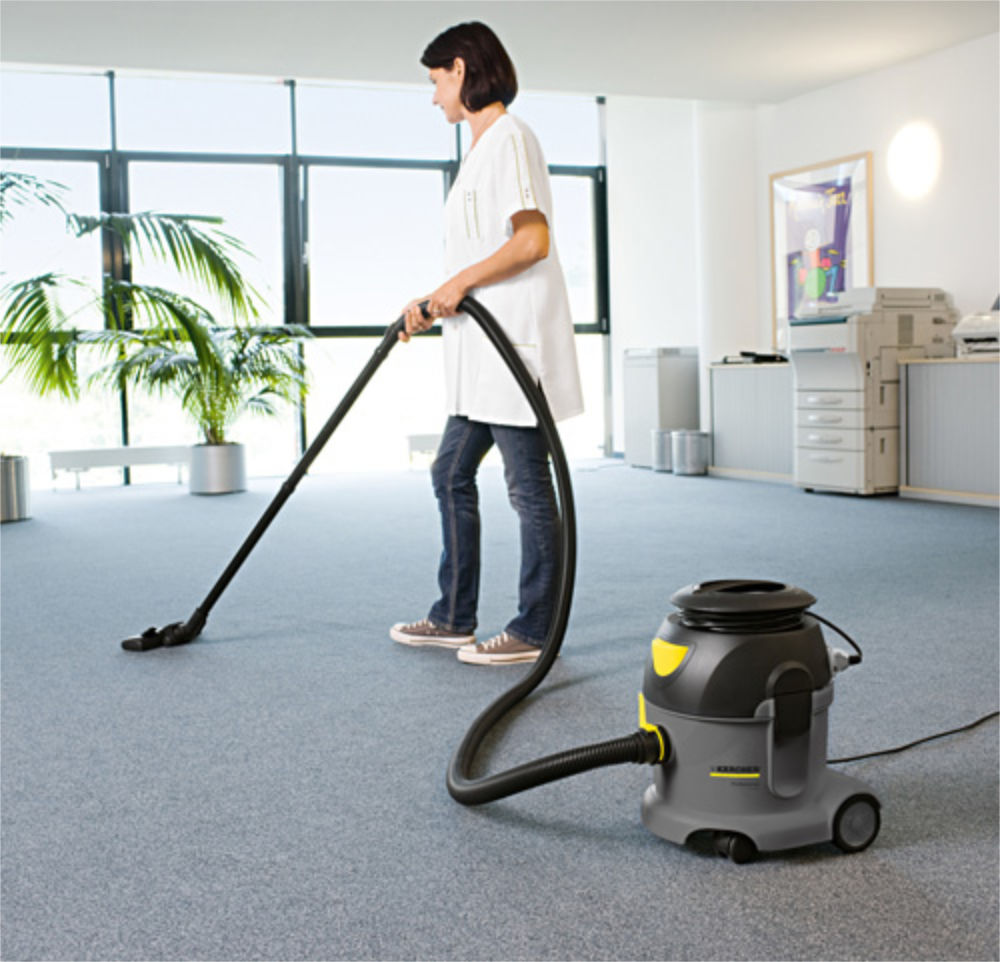
For carpets, rugs and everyday dry debris, a commercial vacuum cleaner such as the Kärcher T 9/1 BP is quick to deploy, and stains from coffee, tea or red wine are best treated with a specialist stain remover.
On hard floors, wiping by hand is common, but above 100 square metres a compact scrubber dryer such as the Kärcher BR 30/4 C BP or BR 35/12 C BP gives a deeper clean, loosening dirt and lifting it away for a more hygienic finish. A disc brush suits smooth floors and a roller brush suits rougher surfaces. A low-foaming detergent reduces the risk of slipping after cleaning.
Interim
It's also important to prevent the big deep cleans. Less frequent jobs reduce how often you need intensive, time-consuming deep cleaning, and they're best done with minimal disruption alongside your daily routine.
For hard floors, the one-step method applies a cleaning agent through a scrubber dryer so the surface is scrubbed, the dirt loosened and the solution lifted in a single pass. Match the brush type (roller or disc) to the floor, the brush or pad material (hard or soft) to the dirt, and the volume of the cleaning agent to how soiled the floor is. Roller systems are more efficient than discs because of their higher contact pressure and speed.
For carpets, our carpet extractors have a dual cleaning mode that lets you switch between a deep clean and a low-moisture maintenance mode, which is ideal for offices, schools, hotels and shopping centres where cleaning time is limited.
Restorative
Restorative cleaning brings surfaces back to their original condition when regular cleaning isn't enough or as part of a planned schedule.
A spray extraction machine such as the Puzzi 10/2 Carpet Cleaner uses spray pressure to loosen dirt in carpets, rugs and upholstery and extracts it in one motion. The surface is then rinsed and vacuumed once completely dry. This method can also be used on upholstery and mattresses, and can be followed with a fibre-protecting agent.
On hard floors, a two-step method applies the cleaning agent first, scrubs side to side, and then removes the dirt with the scrubber dryer. It suits surfaces such as linoleum and PVC, and a protective coating can be added afterwards.
If wooden floors become dirty and normal cleaning isn't working, the one-step method can help: apply a surfactant-free cleaner with the scrubber in the same direction as the wood grain, then, once the floor is dry, restore the surface with wax or oil and use a scrubber with soft polishing brushes.